
Are you considering whether to choose OLED or QLED for your business? Although OLED and QLED have similar names, they are actually two completely different panel technologies. This article will analyze the differences between the two to help you make the right decision.
What Is QLED?

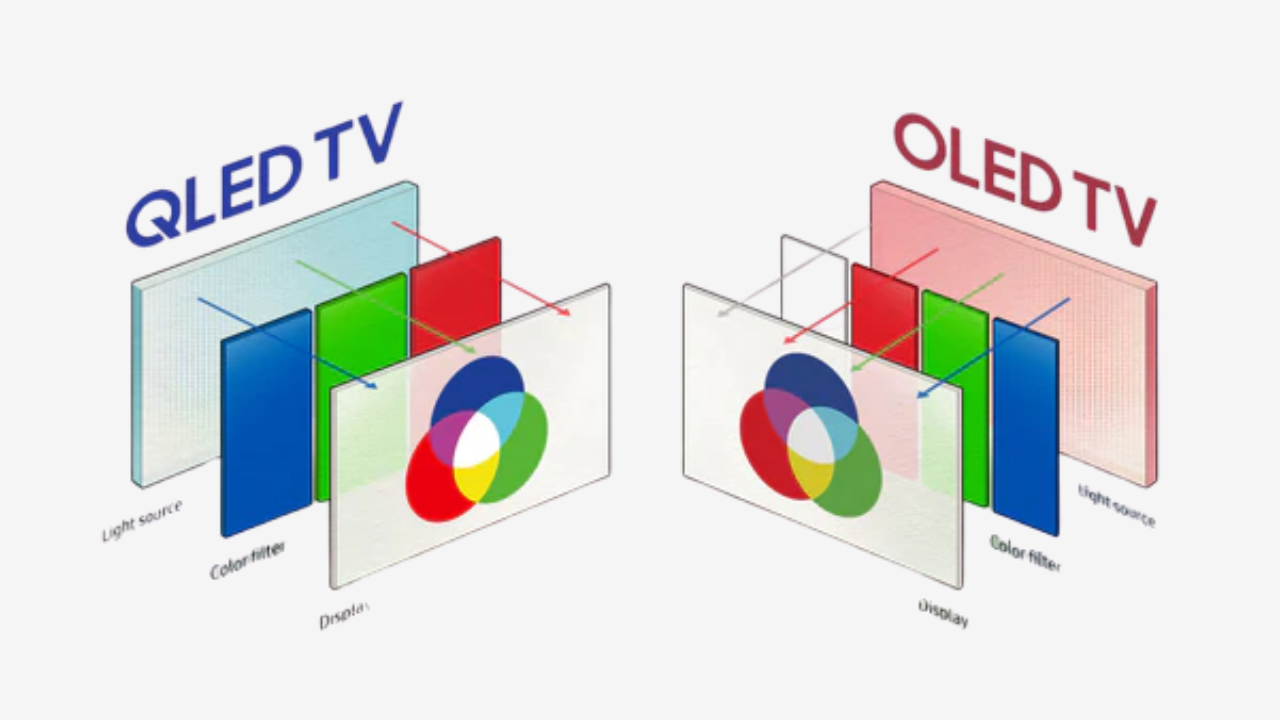
QLED stands for ‘Quantum Dot Light Emitting Diode’. As the name suggests, QLED displays are essentially still LED or LCD screens. QLED displays are characterised by their exceptional brightness.
Flagship models from brands such as Samsung, TCL, and Hisense all utilise this technology. Virtually all mid-range and entry-level televisions from various manufacturers are also equipped with QLED displays.
What Is OLED?

OLED is a self-emissive technology in which each pixel can be controlled independently. As a result, each pixel emits light by itself without affecting the surrounding pixels. This enables OLED displays to reproduce rich shades of black. OLED displays also offer wide viewing angles, extremely fast response times, and vivid colours.
OLED vs QLED: Key Differences
Black Levels and Contrast
OLED is a self-emissive structure in which each pixel can be switched on or off independently. When the screen needs to display black, the relevant pixels can be switched off without relying on a backlight. This virtually eliminates light leakage, resulting in exceptionally deep blacks and images with near-infinite contrast.
In fact, OLED is better suited to applications that require high-definition display performance in dark environments, such as cinema-quality viewing and display devices in dark conditions.
If your viewing environment is quite bright, or if you wish to enhance the overall brightness, you might consider opting for a QLED display.
Brightness
QLED displays typically offer higher peak brightness, giving them an advantage in brightly lit living rooms or rooms with lots of windows. Even in very bright conditions, QLED displays remain clear and are less susceptible to the effects of ambient light.
Although OLED displays have seen a significant improvement in brightness compared to earlier models, they still lag behind QLED. If we exclude the more advanced new-generation OLED products, this gap becomes even more pronounced.
Therefore, in more complex lighting conditions—such as when there is a high demand for daytime viewing or indoor lighting is particularly bright—QLED offers a distinct advantage. Conversely, where the environment allows for controlled lighting—such as when watching at night or in relatively dimly lit spaces—the advantages of OLED become more apparent.
Color Accuracy
Almost all OLED displays support HDR and can display over 100 million colours, resulting in exceptionally clear and vivid images. OLED screens are not particularly bright. In bright environments, their colour reproduction is not as vivid as it is in dark settings.
QLED uses quantum dot technology to transform backlighting into purer colours. Whether it’s the subtle gradations of a field of flowers or the intricate texture of an animal’s fur, it reproduces them perfectly.
Viewing Angles
When viewing QLED from an off-center angle, there will usually be some level of brightness reduction and color shift. When you are not sitting directly in front of the screen, the picture will not be as stable.
OLED offers a more significant advantage in this regard. As each pixel emits light independently, the overall consistency of the image is excellent even when viewed from the side, with relatively minor variations in colour and brightness. Generally speaking, a noticeable drop in brightness or slight colour distortion is only perceptible when viewed from extremely wide angles.
Burn-in Risk
“Screen burn-in” is a phenomenon where an image remains visible on the screen.
In OLED displays, each pixel emits light independently due to the presence of organic materials. If certain areas display the same content for an extended period, a reduction in brightness may occur, resulting in uneven brightness levels.
However, it is important to note that technological advancements have significantly reduced this issue in current OLED technology. Under normal conditions of use, this is unlikely to occur.
Because of the backlight and quantum dot structure, QLED itself does not have the risk of screen burn. It is more suitable for displaying static content for a long time or high-intensity usage, such as gaming, monitoring, or commercial displays.

Screen Size & Budget
When choosing a commercial display, it’s not just about looking at the parameters themselves. What’s more crucial is whether it can be used stably in your business, and whether the budget and subsequent maintenance can work in harmony.
Budget is a practical issue. QLED is usually easier to implement on large scales. You can choose from different sizes and price ranges to make the project more flexible. Although OLED also offers options ranging from 42 inches to 77 inches, the overall price is still relatively high. It would be more suitable for small-scale use. For large-scale installation, the cost pressure will be significantly higher.
If your project involves screens over 85 inches, we recommend the QLED. On one hand, there are more options available; on the other hand, the cost and delivery stability can be better controlled, making it less likely to exceed the budget.
Longevity
After long-term use, QLED devices can maintain their brightness and color performance relatively stably, making them suitable for projects that require continuous operation.
After prolonged use, the brightness of OLED displays will naturally diminish to some extent due to the inherent properties of the organic materials used. OLED has undergone numerous optimisations, such as pixel compensation and brightness management mechanisms. In practical use, these changes are usually gradual and, for most standard commercial applications, have virtually no direct impact on the viewing experience.
Applications
If your project is at the higher end of the market—such as hotel rooms, retail display areas, or spaces where image quality is particularly important—OLED will deliver the best results. Its fine picture quality and high contrast will be a real asset.
However, if the display is in a meeting room or a public area for a long time, QLED would be more convenient. It offers more stable brightness, better durability, and is not likely to be affected by changes in ambient light.
OLED vs QLED: Quick Comparison for Commercial Buyers

| Comparison Factor | OLED | QLED |
| Black Levels and Contrast | True blacks (pixel off), extremely high contrast | Deep blacks with local dimming, but not true black |
| Brightness | Moderate brightness | Higher brightness, better for bright environments |
| Color Accuracy | Very accurate, natural color reproduction | High color brightness, slightly less natural in dark scenes |
| Viewing Angles | Excellent, minimal color shift | Good, but slight color shift at extreme angles |
| Burn-in Risk | Higher risk under long static content use | Very low risk |
| Screen Size and Price | Limited large-size options, higher cost | More flexible sizes, generally more affordable |
| Longevity | May degrade faster in 24/7 commercial use | Generally longer lifespan for continuous operation |
FAQ
Is OLED Better than QLED in All Cases?
No. OLED is not superior to QLED in all cases. It depends on the usage environment and requirements. QLED is better suited to environments with bright light or high-brightness displays, whilst OLED is better suited to scenarios where high picture quality and contrast are required. In well-lit environments, OLED displays can operate for a long time. It has more stable performance in retail, signage, and meeting rooms.
Are OLED TVs Worth the Higher Price?
OLED is more suitable for users seeking ultimate picture quality, black display performance, and a cinema experience. But it comes with a higher price. QLED has advantages in bright environments, longer usage, and cost-effectiveness. Whether it’s worth it depends on the usage scenario and budget requirements.
Can QLED Match OLED Black Levels with Local Dimming?
QLED displays with local dimming are actually a significant improvement over traditional LCDs. By controlling the backlight brightness in specific zones, they can produce deeper blacks and better contrast. The overall viewing experience is more than adequate for most commercial settings.
However, if you’re particularly sensitive to black levels, you’ll notice the difference. QLED still relies on a backlight, so there’s occasionally a slight halo effect in dark scenes, which is particularly noticeable around the edges of bright objects. In contrast, OLED uses self-illuminating pixels, with black simply achieved by turning them off, so it appears cleaner and purer in truly dark scenes.
Do QLED Displays Have Burn-in Issues?
Because of the use of quantum dots and the backlight structure, QLED carries virtually no risk of screen burn-in. Its overall cost is usually more affordable, and the budget pressure will be smaller. If your project places greater emphasis on durability, stability, and cost-effectiveness, QLED is often a more reliable choice, and the maintenance and usage costs can also be more easily controlled.
Will OLED Get Brighter over Time?
No.OLED does not become brighter with use. Due to the aging of the organic light-emitting materials, their brightness gradually decreases. Under long-term high-load usage, this attenuation becomes more pronounced.
Can OLED or QLED TVs Be Wall-mounted?
Both QLED and OLED can be wall-mounted.
However, if you are more concerned about the overall visual effect of the space, OLED will have an advantage. Because it is a self-illuminating structure with no backlight module, the entire device can be made thinner and lighter, and it will fit the wall more closely. Although QLED models can also be wall-mounted, they are slightly thicker and heavier, making them suited to practical installation. It is more of a practical installation solution. If your project is more focused on functional display or your budget is limited, QLED is also completely fine.
Final Thoughts

As a professional LED display screen supplier, we can offer reliable commercial display solutions with strict quality control and comprehensive project support. If you encounter any difficulties when choosing a display screen, please feel free toContact us at any time.

