

Certified for Global LED Projects


One Stop LED Screen Solution for Your Project
- 4K Ultra HD Resolution – Crystal-clear visuals
- High Brightness (5000-10,000 nits) – Perfect for outdoor use
- Seamless Splicing – Custom sizes for any space
- Energy-Efficient – Lower power consumption
- Long Lifespan (100,000+ hours) – Durable & low maintenance
Custom LED Screen Solutions by JingyLED
Our LED screens feature a modular design and can be customised in various sizes, shapes and heights, including giant and ultra-thin LED displays. Currently, our product line covers multiple series, including indoor, outdoor, rental, fixed installation and small pitch, and is used in many fields. We have also obtained multiple patents.
You can rest assured that our LED screens comply with global quality standards and have obtained CE, EMC, LVD, FCC and UL certifications.
Additionally, the complete front-end maintenance and magnetic modules simplify maintenance, minimise downtime, and ensure customer satisfaction.

A stylish, immersive screen ideal for dynamic advertising and architectural installations. Its flexible design enhances audience engagement in retail and event spaces.

Portable and easy to install, it is the perfect choice for temporary events and exhibitions. Lightweight and durable, it delivers high-resolution visuals anytime, anywhere.

50%-90% Transparency, A cutting-edge transparent screen that seamlessly integrates digital content with the real world. Perfect for storefronts, museums, and futuristic-style displays.

Bendable and adaptable, ideal for creative installations in curved or non-traditional spaces. Delivers vibrant visuals and seamless flexibility.

Weather-resistant, high-brightness screens designed for billboards, stadiums, and public signage. Ensures clear visibility even under direct sunlight.

Combines transparency with exceptional visual quality, ideal for modern retail and corporate displays. Enhances aesthetics while maintaining visibility.

High-quality digital signage for worship, live streaming, and event announcements. Clear text and visuals enhance the congregation experience.

Pixel Pitches: P1.2 to P10, Clear and vibrant screens for meeting rooms, retail stores, and control rooms. Energy-efficient and customisable for various indoor applications.

Extra-large high-definition screens suitable for stadiums, concerts, and outdoor advertising. Deliver stunning visual effects at any size.

Pixel Pitches: P3 to P20, Durable and weather-resistant, providing bright and long-lasting visual effects. Ideal for advertising, traffic signs, and public information screens.

Digitally replaces traditional posters with dynamic content functionality. Perfect for retail promotions and public information dissemination.

Provides a 360° viewing experience for shopping malls, lobbies, and exhibitions. Features a striking cylindrical design paired with full-colour visual effects.

A unique spherical LED screen offering an immersive brand promotion and entertainment experience. Ideal for planetariums, events, and interactive exhibitions.

A rolling message board that updates information in real-time at bus stops, banks, and retail stores. Compact and portable yet powerful.

A compact high-resolution screen suitable for small digital signage and interactive information kiosks. Ideal for viewing details up close.

Enhanced depth visual effects for an immersive viewing experience without the need for glasses. Ideal for exhibitions and high-end advertising.

Lightweight and easy-to-move screen, ideal for trade shows, concerts, and pop-up events. Quick setup with professional-grade visual effects.

Fully customisable screen with control over dynamic content. Ideal for live events, retail, and digital art installations.

A multi-faceted LED cube, perfect for 360° advertising and art displays. Captivates attention from every angle.

A vibrant high-definition screen that delivers vivid images in any environment. Supports rich colours and smooth dynamic effects.
Why Choose JingyLED Screen?
- Excellent brightness and contrast for realistic image effects
- High refresh rate for smooth video playback
- Lightweight modular design for easy installation and maintenance
- Our displays feature automatic brightness adjustment and a wide viewing angle (140°-160°), enabling seamless indoor/outdoor integration and outstanding performance in any environment.
- IP45 and IP65 protection ratings ensure dust, moisture and weather resistance, suitable for outdoor use.

LED Display Manufacturer in China


With over a decade of experience, JingyLED offers advanced LED display solutions for a wide range of applications, including advertising, events, sports, retail, entertainment, and exhibitions. Whether you need curved LED displays, transparent LED displays, flexible panels, or interactive XR screens, JingyLED provides customisable options to meet the needs of any project.
Flexible Installation Options From JingyLED
Whether you need wall-mounted, hanging, floor-standing, stacked, or curved screen configurations, JingyLED provides reliable installation solutions for quick and safe installation.

Wall-mounted LED displays are ideal for environments such as offices, conference rooms, and control centres, seamlessly blending with interior design and providing clear visual effects when viewed up close.

Floor-standing LED displays are commonly used in trade shows, exhibitions, lobbies, and public information areas. They are portable, easy to install, and allow for frequent movement.

Ceiling-mounted LED screens are ideal for concerts, stadiums, large events and theatrical performances, maximising audience visibility without taking up valuable floor space.

Stacking installation is ideal for temporary setups or events that require quick assembly, such as large outdoor LED screens for concerts or sporting events, exhibition display walls, and vertically stacked rental LED displays, which can be flexibly adjusted in height.

Curved screens are used for immersive or creative visual effects, such as curved or circular LED screens in commercial centres and technology museums, and XR virtual production studios equipped with curved LED walls, providing an immersive shooting experience.
The Projects We Have Collaborated On

A commercial complex located in the Mediterranean coastal area planned a roadside advertising LED billboard for 24‑hour round‑the‑clock commercial playback. The site suffers high humidity and salt‑fog corrosion from ocean wind. JingyLED delivered a 32㎡ P4.81 outdoor fixed LED display equipped with auto brightness adjustment and full IP65 protection rating. Adopting front‑maintenance cabinet structure, the screen can reach over 100,000‑hour service life. It resists salt‑fog erosion effectively, and module replacement can be completed without heavy lifting equipment, and lower long‑term maintenance workload.

A flagship retail brand store in France intended to add digital advertising content on its existing glass facade, without blocking natural indoor lighting or demolishing original building structures. JingyLED provided P3.9 transparent LED panels covering total area of 42㎡, featuring 70% transparency and 12.5 kg lightweight per cabinet. Panels are directly mounted on glass frames. It presents eye‑catching dynamic ads for street pedestrians while preserving daylight inside the shop and maintaining outward vision for in‑store customers.
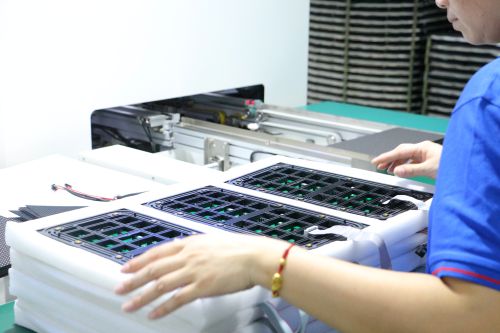
- Our Factory
- Technical Specifications




| Viewing Angle | 140°-170° |
| Brightness | Up to 10,000 nits (outdoor) |
| Refresh Rate | 1920Hz-7680Hz |
| Contrast Ratio | 5000:1 – 10,000:1 |
| Power Consumption | Energy-saving design |
OLED offers better contrast, deeper blacks and a slimmer design, making it ideal for high-end indoor applications. LED displays are brighter, more durable and more cost-effective, making them ideal for large outdoor or commercial applications. For most signage needs, LED is the more practical choice.
LED display prices vary based on pixel pitch, size, and installation type. Indoor screens typically range from $600–$1,200/m², while outdoor displays range from $450–$950/m². Special types like transparent, curved, or 3D LED displays cost more, usually $1,000–$2,500/m².
For accurate pricing, please send JingyLED your detailed requirements to request a custom quote.
IPS offers better colour accuracy and wider viewing angles, making it ideal for monitors and indoor use. LED displays are brighter and better suited for large or outdoor applications. Choose IPS for image quality, and LED for size and brightness.
How LED Display Works?
The working principle of LED display screens involves using light-emitting diodes (LEDs) as pixels to create images. Each pixel consists of red, green, and blue (RGB) LEDs, which combine to produce a full-colour visual effect. Under the control of a driving system, the LEDs emit light in specific patterns to display text, images, or videos, making them ideal for signage, advertising, and digital display screens.
How to Choose the Right LED Screen for Your Project?
Choosing an LED display is not just about pursuing the highest resolution or lowest price. The right configuration depends on your applications, viewing distance, indoor or outdoor environment, content type, installation conditions, and total project budget. The following factors can help you determine the appropriate LED screen specifications before quoting.
Define Your Specific Application
First, determine where you will use the LED screen, as different projects have very different requirements for display effect, brightness, structure and installation method.
For example, meeting rooms and control rooms are usually suitable for fine pitch LED screens, such as P0.9-P1.8; advertising screens used in shopping malls and retail stores usually focus more on visibility and long-term operational stability; for concerts, stages and exhibitions, rental LED screens that are lightweight and easy to assemble are more suitable; if it is used for outdoor advertising or building facades, you should focus on outdoor fixed LED screens, building LED screens, etc.
Decide Whether It is Indoor or Outdoor
Indoor LED screens usually do not require particularly high brightness and protection levels, but they need to consider the picture quality at close distances, the display effect under low ambient light conditions, and the installation space; Outdoor LED screens, on the other hand, require higher brightness and consider waterproofing, dustproofing, and heat dissipation based on local weather conditions. If it is installed on the building exterior, you also need to further evaluate wind load, installation structure and maintenance space, and cannot simply choose the display based on the screen area.
| Factor | Indoor LED Screen | Outdoor LED Screen |
| Brightness | About 600-1,500 nits | About 5,000-7,000+ nits |
| Pixel Pitch | P0.9-P3.9 | P3.9-P10+ |
| Weather Protection | Usually not necessary | IP protection required |
| Often Used For | Meeting, Retail, Showroom | Billboard, Stadium, Building |
| Main Concern | Close-view image quality | Sunlight & weather resistance |
Determine Viewing Distance
The closer you are to the screen, the easier it is to notice the spacing between the LED pixels. So when viewing closely, a smaller pixel pitch is usually required; if the audience is farther away from the screen, there is no need to pay extra costs for a higher pixel density.
A commonly used initial estimation method is to roughly correspond the pixel pitch (mm) to the minimum comfortable viewing distance (m). For example, P2.5 can be taken as a reference starting point around 2.5 meters, but its actual effect will also be influenced by the content type, screen size, and main viewing position. Therefore, it is not recommended that you take this rule as an absolute standard.
Select the Appropriate Pixel Pitch
Pixel pitch refers to the distance between adjacent LED pixels. It would be more reasonable to choose the pixel pitch after determining the viewing distance. Below, I will provide you with a table for reference to help you strike a balance between picture details and project costs, rather than simply choosing the smallest pixel pitch.
| Pixel Pitch | Typical Viewing Distance | Best For |
| P0.6-P0.9 | 1-2 m | Premium boardrooms, control rooms, studios |
| P1.2-P1.5 | 1.5-3 m | Conference rooms, showrooms, control rooms, retail |
| P1.8-P2.5 | 2-5 m | Retail stores, exhibitions, corporate spaces, hotels |
| P2.6-P3.9 | 3-8 m | Stage, concerts, events, exhibitions, churches |
| P4-P6 | 5-15 m | Outdoor advertising, stadiums, public spaces |
| P8-P10+ | 10 m+ | Billboards, building facades, large venues |
Select the Brightness Based on Ambient Light
The LED screen’s brightness should be determined according to the surrounding ambient light, rather than being as high as possible.
For indoor projects, typically 600-1,500 nits is sufficient to cover many applications; if installed in a retail space with a lot of glass facades or strong ambient light, a higher brightness may be required. Outdoor screens need significantly higher brightness. Many outdoor solutions consider 5,000 nits or above, and in environments with direct sunlight exposure, higher configurations may be necessary.
Besides brightness, you should also consider whether automatic brightness adjustment is needed, as adjusting the brightness according to the ambient light during all-day operation can improve the viewing experience and avoid unnecessary energy consumption.
Choose the Refresh Rate
For ordinary advertisements, meetings, or digital signage, the highest specification is not necessarily required; however, if the screen needs to be captured by a camera, live equipment, or broadcasting system, you need to pay attention to the refresh rate.
For example, for displays used in stages and events, you can prioritize 3,840 Hz+ to reduce the risk of flickering, scan lines, or black lines in the captured video; professional broadcasting, slow-motion shooting or XR require a higher refresh rate.
We recommend that you clearly state the requirements for camera shooting or broadcasting during the quotation process so that we can better configure for you.
Determine Cabinet Design
The cabinet design not only determines the LED screen’s appearance, but also affects transportation costs, installation efficiency and later maintenance. If your project requires frequent transportation and disassembly, you can choose a lightweight LED screen cabinet; if it is a long-term fixed installation, you should focus on structural strength, heat dissipation, maintenance methods and the connection with the steel structure.
Confirm Installation Conditions
You should also confirm the actual installation conditions, including wall or structural load capacity, installation height, power supply, cable routing, and local environmental conditions.
For large outdoor construction projects, you had better consider wind load, waterproofing, and maintenance space; for lifting projects, it is necessary to confirm lifting points, total weight, and on-site safety requirements.
If you already have CAD drawings or on-site photos, please provide them directly to us so we can complete structural and installation design evaluations prior to production.
Consider the Total Project Cost
When purchasing an LED display, you shouldn’t compare prices solely based on cost per square meter. The actual project cost typically includes LED cabinets, control systems, power distribution, steel structures, installation accessories, spare parts, packaging, shipping, and commissioning, etc.
Therefore, for the same 50 m² P2.5 LED screen, if one supplier offers only the bare panel while another includes the control system, spare parts, and other supporting components in their quote, their final procurement costs could differ significantly.
LED Screen Maintenance Guide: How to Reduce Downtime and Repair Costs
Common LED Screen Problems and How to solve
Dead Pixels
If a single or some local light bulbs on the LED screen fail to light up, it is usually related to the driver IC or the module circuitry.
A few bad points can be replaced by changing the bulbs; if there are large areas or continuously increasing bad points, you should check the module quality and the driving system.
Module Failure
If an LED module shows black screen, flickering, abnormal color or fails to display normally, it might be a fault in the module, the wiring, or the connection interface.
You can first check the power supply and signal connections, and then replace the faulty module. Adopting a standardized and easily disassemblable module design can lower your repair time significantly.
Receiving Card Failure
The receiving card is responsible for receiving and processing the display signals from the control system. In case of failure, it may cause partial black screen, distorted screen or signal loss.
You can locate the problem by checking the indicator lights, network cables and the connection between the sending card/controller. If necessary, replace the receiving card and reconfigure the parameters.
Brightness Inconsistency
When there are differences in brightness, color temperature or color among different modules or enclosures, it is usually related to the batch of LED light beads, correction parameters, usage time or driving system. This issue can be resolved by re-calibrating the brightness and color parameters.
Water Ingress
If the outdoor LED display is poorly sealed, has insufficient drainage design, or has problems with the installation structure, rainwater may enter the box and cause short circuits, corrosion, or damage to components.
After discovering water infiltration, you should cut off the power supply immediately and inspect the box, sealing strips, connectors, and drainage structure; for outdoor projects, the corresponding protection level should also be confirmed based on the installation environment.
Front Maintenance vs Rear Maintenance
Front maintenance usually removes the modules or key components from the front of the LED screen, eliminating the need for a large maintenance space behind the screen. As a result, it is suitable for wall-mounted, recessed installations, and projects with limited space.
Rear maintenance, on the other hand, involves conducting repairs and replacements from the rear of the screen, typically requiring a maintenance passage. However, for large fixed installation projects, maintenance is more convenient when there is ample working space at the rear.
| Comparison | Front Maintenance | Rear Maintenance |
| Access | From the front | From the rear |
| Space Required | Minimal rear space | Requires rear access space |
| Installation | Wall-mounted, recessed, space-limited areas | Freestanding structures, outdoor installations |
| Maintenance | Quick module and component replacement | Convenient when rear access is available |
| Best For | Indoor LED walls, retail, conference rooms,etc | Outdoor LED screens, stadiums, building displays,etc |
LED Screen vs LCD Video Wall
LED screens and LCD video walls can both be used in meeting rooms, control rooms, exhibition halls, retail stores, advertising, and large-scale commercial display projects. However, their technical structures and applicable areas are different.
An LED screen composes a large number of LED modules and can be customized according to your project’s size, ratio, and installation structure, and can form an LED video wall with an ultra-large size and nearly seamless display effect; the LCD video wall is made up of multiple liquid crystal display units and has standardized dimensions, but there will be obvious seams between the screens.
For projects requiring ultra-large customized sizes, long-distance viewing, or high-brightness outdoor display, LED screens are usually more suitable; for standard sizes, close-range indoor display, and projects with relatively controlled budgets, LCD video walls can be used as an alternative solution.
| Feature | LED Screen | LCD Video Wall |
| Seam | Near-seamless display | Visible bezels |
| Size | Highly customizable | Limited by panel size |
| Viewing Distance | Flexible with different pixel pitches | Best for close to medium distances |
| Installation | Indoor & outdoor | Mainly indoor |
| Maintenance | Front or rear access options | Panel replacement |
| Cost | Depends on pixel pitch, size and configuration | Standardized pricing |
| Best For | Large, custom, high-brightness displays | Standard indoor video walls |