
The impact of AR and VR experiences is significantly enhanced when they are used together with large LED display walls. This combination enables the creation of flat visuals into spatial and immersive environments that are suitable for professional projects.
A lot of companies have already turned to this technique for the clear and large-scale presentation of their ideas, simulations, and stories.
Understanding Extended Reality (XR) LED Display
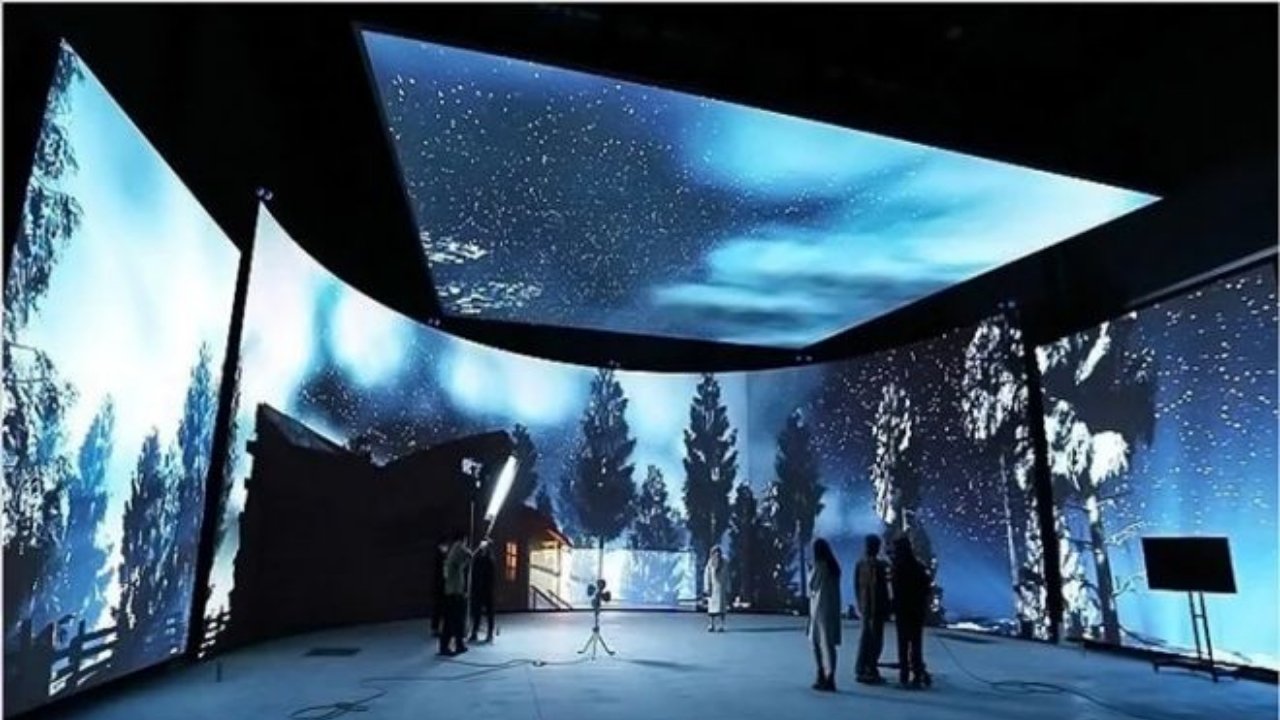
Extended Reality which is commonly known as XR, totally integrates augmented reality and virtual reality into one visual display. The LED display walls are the primary surface where the digital content is shown vividly, large, and uniformly.
This arrangement facilitates the creation of realistic depth, accurate scale, and shared viewing experiences.
LED walls as opposed to traditional screens are made up of modular panels that seamlessly form visual canvases. Every panel has direct light emission, which results in improved brightness and contrast. This design helps XR content to be very clear even in tough conditions.
· Augmented Reality in LED Wall
AR adds digital elements to the visuals that are displayed on your LED wall. The graphics and animations match the physical references for better understanding. This neatness gives you the ability to make complex information easily understandable to your team.
· Virtual Reality in LED Wall
VR generates lifelike environments on the LED wall without the necessity of headsets. Huge visuals occupy the area, thereby making the scenes immersive and captivating. Your simulations are enhanced with sophisticated motion and true-to-life colors to make the experience more realistic and professional.
Why Combine AR and VR in LED Wall

Integrating AR and VR on LED walls results in a single cohesive visual system. Such a system enhances interaction, realism, and scalability in professional fields.
- Greater Engagement and Immersion: VR environments and AR overlays attentively hold focus through depth of a given space. The ability to engage a visual medium through interaction feels natural and intuitive.
- High Brightness and Visibility: LED walls provide the best quality digital images. The digital images and contents can be seen clearly without any area being dimmed.
- Seamless Integration: The display units are joined together in such a way that there are no visible borders. Switching between AR and VR is unobtrusive.
- Scalability: The use of modular panels makes the wall size easily adjustable. Various project scopes have ideal visual scale.
- Flexibility: The same system allows for simulation, visualization, and presenting. Content is easily adjustable for a range of industries.
How AR and VR Integrates with LED Display Walls

· AR Overlays on LED Walls
AR overlays insert digitally produced information directly on the top of visuals displayed on your LED wall. A software application works to keep graphics in sync with the background content for precise positioning. Such a high degree of clarity allows you to grasp the information very easily while being able to see the visuals at the same time.
· VR Immersive Environment
The stand-out feature of VR on LED walls is that it makes a very large surface area available for displaying digital images. You can see all the details and proportions perfectly without being obliged to wear the headset. The display set-up is very comfortable and allows for interaction while simulating and reviewing the design.
· Hybrid Augmented Reality and Virtual Reality Experiences
Hybrid systems allow the blending of the AR and VR technologies on the same LED wall. A single visual space is created where real data can interact with virtual environments. This versatility enables a wider range of complex presentations and technical visualization.
Design and Setup Considerations

Technical Requirements
· Resolution and Pixel Density
The pixel pitch measurement determines the sharpness of an image at a close distance. Sharper pixel density levels create more detailed graphics and text. This clarity is important during technical presentations.
Reducing the visible spacing between pixels is done through higher resolution. Enhancing visuals even further is important for XR experiences. These experiences are meant to be immersive.
· Latency and Synchronization
There is a direct correlation between low latency and the omission of disruption during XR experiences. XR experiences are meant to be seamlessly aligned. Great processed layers do not add response gaps.
Evenly spaced time intervals promote smooth motion alignment. This provides a sense of comfort to the viewer.
· Brightness and Color Calibration
Making adjustments to the brightness of the walls provide a more even and uniform visual experience. In between the color walls of the various panels, poor alignment of the color output leads to inconsistency of colors. The more consistent the colors are, the more accurate the visuals appear.
Design evaluation is more valuable with accurate color reproduction. Keeping colors consistent over time makes visual trust of the design increase, especially during critical reviews.
· Refresh Rate and Synchronization.
Displays with high refresh rates have less motion blur and a much lower degree of flicker. VR movements look real and smooth, leading to a comfortable viewing experience. Long sessions do not cause eye tiredness as there is no visual strain.
The synchronization of the screens means that the same image is displayed all over the monitor at the same time. The animations are continuously flowing and no gap or change in the picture quality can be seen. This accuracy not only allow you to focus better but also keeps the experience pleasant and interesting.
Hardware and Software Integration
· Compatible AR/VR Platforms
Systems need to be compatible with the top XR engines. This way the integration streamlines the deployment of content and retains flexibility for future growth.
· Content Management Systems
The ability to quickly update, schedule and manage content from a central location keeps content organized and consistent. This control also streamlines operations and workflow.
Installation Environment
· Ambient Light Control
LED walls are better than projection screens at managing ambient light, and also offer better contrast with controlled lighting. Balanced lighting conditions enhance the visual experience.
· Size of Room
The dimensions of the room determine the size and resolution of the walls. Good scaling avoids distortion. Proper spatial planning allows for comfortable viewing.
· Viewing Angle
Excellent image quality is retained across positions with wide viewing angles. This is useful for collaborative work as visuals remain constant. This promotes interactivity, especially in groups.
Compare AR/VR with LED Walls vs Traditional Displays

Characteristics | AR/VR with LED Display Walls | Traditional Displays |
Brightness | High and even | Moderate brightness. |
Immersion | Spatial and surrounding | Flat and segmented. |
Elasticity | Detachable and adjustable | Fixed dimensions |
Visual Scale | Huge and contiguous surfaces | Restricted screen size |
Common Challenges with AR/VR LED Displays

Although there are some strong advantages AR and VR LED displays, there are a number of technical and operational issues that can arise and they include:
· Moire Patterns
Sometimes the pixels are not correctly aligned, leading to what is known as Moiré Patterns. This effect can be minimized through the appropriate selection of cameras and panels along with good setup.
· Latency
Delays in processing and display can be disruptive to interactive experiences and can lead to inaccurate responses in a virtual environment. This can be mitigated through optimized processing and synchronization.
· Cost and Scale
Smaller installations can even be quite expensive, but larger installations can be prohibitively expensive. Having a well-defined plan can help ensure the installation at the optimal performance level while staying within the budget.
Industry Applications of AR/VR LED Display Wall Systems

In a number of business settings, AR and VR LED displays help to enrich training, collaboration, and visualization experiences.
· Entertainment Industry
LED display walls can be used for virtual staging and dynamic backgrounds for film and TV as well as live events. VR and AR environments can support real-time production workflows instead of using physical sets.
· Education and Training
Training programs incorporate the use of AR and VR LED walls for safe but realistic scenario simulations. The large displays facilitate group participation, thus making the complex processes easier to grasp and practice.
· Corporate and Retail
LED display walls show products and ideas in real-life proportions. At presentations, exhibitions, and brand experience events, AR and VR provide interactive visuals to simplify elaborate concepts.
· Healthcare
LED walls in medical environments are used primarily for training and procedure planning. The AR makes critical information visible. The VR simulation gives the faculty a chance to rehearse the operation and comprehend the relationship between the body parts in the three-dimensional space.
· Architectural and Design
With the use of LED walls, design teams elevate their work to the next level by visualizing a project at its life-size dimensions. AR adds construction details, allowing teams to better analyze proportions, materials, and relationships in the spaces.
FAQs
Can AR and VR be used together on the same LED wall system?
Indeed, hybrid systems are capable of incorporating both technologies with the help of integrated software.
How does latency affect AR/VR experiences on LED walls?
Latency that is high causes misalignment and inaccuracies in movements.
What resolution is ideal for AR/VR LED display walls?
Very fine pixel pitch is necessary for the close up viewing and detailed content.
Are LED display walls suitable for small spaces?
Of course, modular designs can be modified to fit in small areas.
What makes LED display walls better than projectors for AR/VR?
The absence of shadows and greater brightness are the major reasons.
What are the benefits of immersive technologies in LED displays?
Engagement, clarity, and collaboration are all enhanced through immersion.
Partner with JYLED today for all LED Display from China

At JYLED, we are continuously upgrading our LED displays to feature the latest technologies in the industry. From AR, VR, IoT to 5G, JYLED LED displays are designed to seamless integration with emerging technologies.
We offer many display options with varying pixel pitch, from P5 to P16. While their applications also vary from car LED display, LED poster, LED billboard trailer to truck LED display.
Partner with us today for all innovative LED display designs – explore our product catalogue now.

