

Certified for LED Store Display Projects


LED Retail Store Display Manufacturer
- High brightness and clarity ensure visibility even in direct sunlight, making it ideal for storefront displays.
- Customizable sizes and designs with flexible cabinet and screen options accommodate any store layout or branding needs.
- Supports video, animations, promotions, price updates, and interactive ads.
- Easy installation and maintenance with lightweight panels and optional front or rear access.
- Seamless integration with retail management systems for scheduled promotional campaigns.
High-Quality LED Store Displays for Shops & Malls | JingyLED
JingyLED is a professional LED store display manufacturer in China, specializing in creating high-quality digital display solutions for retail businesses.
Our LED store displays can show various information, such as videos, photos, animations, text, temperature, humidity, and more. All our products are certified with E-MARK, CE, FCC, CSA, ETL, and other international certifications, making them suitable for diverse retail spaces including supermarkets and convenience stores, clothing boutiques, fashion boutiques, and brand stores, restaurants, cafes, shopping malls, retail chains, electronics stores, and more.
Whether placed inside stores for brand or product promotion, or mounted behind glass to attract outdoor foot traffic, JingyLED store displays offer customizable content, sizes, and colors.

Combining transparent glass panels with dynamic visual effects, JingyLED transparent LED displays are perfect for storefront window displays without obstructing the view.

JingyLED advertising posters feature durable LED displays with high brightness, capable of scrolling text, graphics, and videos. They attract the attention of passersby or tourists day or night.

Our indoor LED displays deliver vibrant colors and high resolution for retail stores, shopping malls, and restaurants, ensuring your content captivates audiences and delivers powerful advertising and brand impact.
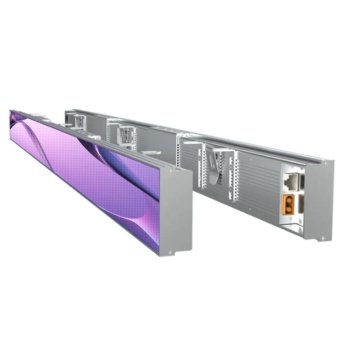
JingyLED LED Shelf Displays are slim, lightweight, and high-brightness, designed for direct installation on store shelves. They are ideal for displaying price tags, promotional information, and product highlights.

JingyLED Column LED Displays wrap around pillars or architectural columns, showcasing advertisements and information in a 360-degree display. They are commonly used in shopping malls, airports, and event venues.

JingyLED digital LED posters are ideal for creating eye-catching advertisements, menus, or informational displays. Featuring portability, plug-and-play functionality, easy installation, wireless control, and vibrant full-color content, they allow for effortless content updates via an app.

JingyLED floor-standing display screens are suitable for hotels, stores, bars, and marketing venues. They feature a brightness of 800–1,000 cd/m², a viewing angle of 160° vertical and 160° horizontal, and a pixel pitch of 2.5 mm. They operate on 100–240 V AC, consume 150 W/m², and have a service life of up to 100,000 hours.

JingyLED portable displays are suitable for indoor, outdoor, and commercial settings. They can be used for advertising, retail stores, shopping malls, food displays, wayfinding systems, airports, hotels, and restaurants. They feature a brightness of 1,000 nits, a pixel pitch of 2.5 mm, and a contrast ratio of 3,000:1.
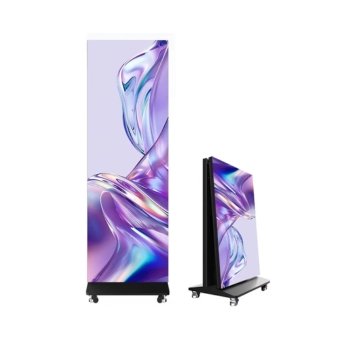
JingyLED foldable LED poster screen display supports the display of video, text, images, time, 3D text, office applications, and SWF files. It supports three control methods: Wi-Fi, USB, and Bluetooth. The screen has a brightness of 800 cd, a pixel pitch of 2.5 mm, and a service life of up to 100,000 hours. This floor-standing display features a viewing angle of 178° horizontally and vertically.

JingyLED double-sided displays are suitable for both indoor and outdoor environments. They are specifically designed for use in advertising, retail stores, shopping malls, food displays, welcome screens, subways, airports, and exhibition halls. They feature a brightness of 6,000 cd, a pixel pitch of 2.5 mm, and a service life of up to 100,000 hours.

Feature a fingerprint-resistant coating and are suitable for use in advertising, retail stores, shopping malls, food displays, wayfinding systems, subways, restaurants, hotels, and airports. They have a brightness of 350 cd, a pixel pitch of 10.4 mm, and a viewing angle of 178° (horizontal/vertical).

Suitable for both indoor and outdoor environments, it can be used in outdoor locations such as storefront windows, residential communities, and hotels. It has a brightness of 1000 cd, a pixel pitch of 2.5 mm, and a refresh rate of 3840–7680 Hz. The display is waterproof and has a power consumption of 50 W/m².

Supports remote content management, real-time status monitoring, and API integration. It features a brightness of 6,500 cd, a pixel pitch of 10 mm, a viewing angle of 140° (horizontal) / 140° (vertical), and a service life of up to 100,000 hours. It is constructed of die-cast aluminum and is waterproof.

This display is available in wall-mounted, suspended, custom-installed, and freestanding configurations, and is suitable for use in advertising, retail stores, shopping malls, food displays, hotels, restaurants, and airports. It features a brightness of 600–800 cd, a pixel pitch of 1.56 mm, and a viewing angle of 170°.

This visually stunning LED display features an ultra-thin design. With a brightness of up to 1,000 cd and a viewing angle of 160°, it delivers vibrant colors and crisp images for indoor advertising.

Equipped with environmental sensors and Wi-Fi hotspot sharing capabilities, it is suitable for use in advertising, publishing, retail stores, shopping malls, and other venues. It features a brightness of 600 nits, a pixel pitch of 1.86 mm, and a service life of up to 60,000 hours.
Key Features of JingyLED LED Store Display

Our seamless LED displays feature high-resolution, borderless screens with high-brightness LEDs, ensuring your messages remain clearly visible day or night.

Update promotions in seconds via Bluetooth using your smartphone. Select fonts and effects, then instantly send content to the display. No technical skills required.

From storefront windows to counters and aisle ends, our displays can stand independently or mount to ceilings. Easy installation adapts to any retail setting.

Our LED displays deliver high precision with modular construction and SMD three-in-one LED packaging technology. Achieving up to 85% transparency, they showcase your content from every angle.
JingyLED – Professional LED Store Display Customization Expert
Our LED store display models include 2.5mm, 3mm, 4mm, and 5mm pixel pitches, with sizes ranging from 55 inches, 68 inches, 80 inches, to 85 inches. You may also send us your desired dimensions or shapes based on your requirements, and we will do our utmost to create the LED store display you envision.
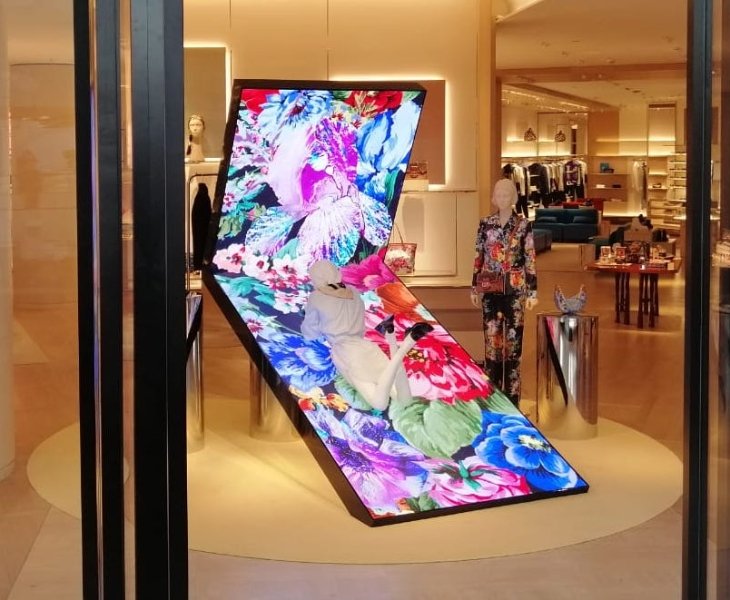
How LED Store Displays Boost Sales and Customer Engagement?


The most fundamental function of LED store displays is showcasing products, prices, and promotional information. However, compared to traditional paper posters or other display methods, LED screens deliver powerful video impact and enable rapid updates anytime, anywhere.
– Indoor and Window Displays: High-brightness, energy-efficient screens capture attention indoors or on the street.
– Supermarket or Mall Promotions: Showcase limited-time offers or new products with real-time updates.
– Navigation and Store Layout: Guide customers through interactive maps or route directions.
– Brand Storytelling: Communicate your brand mission and values to build deeper customer connections.
Experienced LED Store Display Factory in China
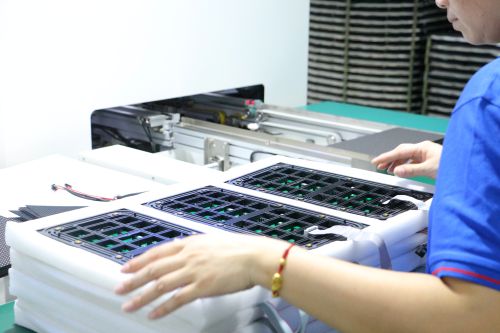
As China’s most professional and longest-established LED display factory, our facility spans over 12,000 square meters. Equipped with advanced production machinery and skilled workers, we guarantee robust delivery capabilities. Before shipment, rigorous testing and debugging ensure flawless professional performance of every display.

All retail LED displays undergo three testing stages and two burn-in processes: post-SMT placement testing, pre-burn-in testing of LED modules, and final pre-shipment testing. LED modules undergo 48-hour burn-in testing first, then are assembled into complete displays for an additional 48-hour burn-in test. Only after passing all inspections are they shipped.

All retail digital signage displays undergo simulated on-site installation at the factory. The LED display control system is configured and debugged according to the actual layout. Upon completion of on-site installation, the display is ready for immediate use.
- Our Factory
- Technical Specifications
- Model Data Sheet(Street-facing Store)
- Model Data Sheet(Mall Boutique)




| Item | Options / Details |
| Product Name | LED Store Display |
| Pixel Pitch | P2.5 / P3 / P4 / P5 |
| Brightness | Indoor: 350 – 1300+ Nits / Outdoor: 4500 – 6000 Nits |
| Refresh Rate | 3840 – 7680Hz |
| Viewing Angle(H/V) | 140° – 170°/140° – 170° |
| Connectivity | HDMI / USB / LAN / DVI / and wireless inputs. |
| IP Rating | Outdoor: Front IP65 / Rear IP54 / Indoor: IP30 |
| Operating Temperature | -20℃ – 60℃ |
| Voltage | AC 100V – 240V |
| Lifespan | Up to 100000 hours |
| Certification | CE / RoHS / FCC / ISO9001 |
| Model | P2.6-5.2 | P2.8-5.6 | P3.91-7.81 | P3.91-7.81 | P10.4 |
| Module Size(mm) | 500×125 | ||||
| Module Resolution(dot) | 384X192 | 352X176 | 256X128 | 256×128 | 96×96 |
| Scanning(s) | 1/12 | 1/11 | 1/8-16-32 | 1/7 | 1/2 |
| Encapsulation | SMD SMD SMD SMD SMD | ||||
| Maintenance | Front/Rear | ||||
| Transparent Rate | 55% | 58% | 62% | 68% | 75% |
| Cabinet Size(mm) | 1000X500/1000×1000 | ||||
| Density(dot/m²) | 73728 | 61952 | 32768 | 32256 | 9216 |
| Brightness(cd/m) | 650-800 3000-4000 | 800-1200 3500/4200 | 1500/2500/4500 | 4800-5500 | 4000-4500 |
| IP Rate | IP31 | ||||
| Refresh Rate(Hz) | 3840 | ||||
| Cabinet Weight (kg) | 8 | 8 | 7.5 | 7.5 | 7.5 |
| Cabinet Material | Aluminum | ||||
| Grayscale | 14-16Bit | ||||
| Frame Change Frequency(Hz) | 50/60 | ||||
| Viewing Angle(V/H) | V160°/H160° | ||||
| Best Viewing Distance(m) | >2.5 | >3 | >4 | >4 | >10 |
| Input Voltage(V) | AC110V±15%/AC220V±15% | ||||
| Max./Avg.power consumption(w) | 600/300 | 600/300 | 400-600/200-300400-600/200-300 600/250 | ||
| Storage Temperature&Humidity(RH) | -10℃~60℃/10%~90% | ||||
| Life Span(h) | >100,000 | ||||
| Model | P1.86 | P2 | P2.5 | P3 | P3.076 | P4 | P5 |
| Module Size(mm) | 320×160 | 320×160 | 320×160 | 192×192 | 320×160 | 320×160 | 320×160 |
| Module Resolution(dot) | 172×86 | 160×80 | 128×64 | 64×64 | 104×52 | 80×40 | 64×32 |
| Scanning(s) | 1/43 | 1/40 | 1/32 | 1/32 | 1/26 | 1/16 | 1/16 |
| Encapsulation | SMD/GOB | ||||||
| Maintenance | Front/Rear | ||||||
| Installation | Front/Rear | ||||||
| Cabinet Size(mm) | 960×960(Customizable) | ||||||
| Density(dot/m²) | 288369 | 250000 | 160000 | 111111 | 105625 | 62500 | 40000 |
| Brightness(cd/m) | 600/800/1200 | ||||||
| IP Rate | IP31/IP43 | ||||||
| Refresh Rate(Hz) | 3840 | ||||||
| Cabinet Weight(kg) | 20 | ||||||
| Cabinet Material | Iron | ||||||
| Grayscale | 14bit | ||||||
| Frame Change Frequency(Hz) | 50/60 | ||||||
| Viewing Angle(V/H) | V160°/H160° | ||||||
| Best Viewing Distance(m) | >1.8 | >2 | >2.5 | >3 | >3 | >4 | >5 |
| Input Voltage(V) | AC110V±15%/AC220V±15% | ||||||
| Max./Avg.power consumption(w) | 600/200 | ||||||
| Storage Temperature&Humidity(RH) | -10℃~60℃/10%~90% | ||||||
| Life Span(h) | >100,000 | ||||||
Yes, our full-color and high-resolution models support basic graphics and logos, allowing your brand to stand out.
Yes. JingyLED LED store displays feature high brightness and anti-glare technology, ensuring clear visibility even in direct sunlight.
Content can be updated via USB, Wi-Fi, 4G/5G, or cloud-based systems, making management fast and convenient.
LED Store Display vs LCD Display: Which Is Better For Retail?

Both retail LED displays and LCD displays can be used for in-store advertising, product displays, and digital signage; however, they are better suited to different retail applications. You can compare them from several aspects.
Compare Screen Size and Seamless Installation
If you need a large or wide display, an LED store display is usually more flexible. It consists of multiple LED modules and cabinets, which can be combined to create different screen sizes based on the available store space. LED displays can also achieve seamless splicing, while LCD displays generally cannot.
In contrast, if you need a standard-size screen for close-up viewing of text and product details, an LED-backlit display may be a better choice.
Compare Brightness and Visibility
For typical indoor stores, the brightness of an LCD display is usually sufficient for basic display needs. However, if your display will be installed in a bright area, like a storefront window or entrance, you can choose an LED display with higher brightness based on the ambient light to keep the content clear.
Consider Viewing Distance and Content
If your customers will view product information, prices, text, or details from a close distance, you can choose a fine-pitch LED display or an LCD suitable for close viewing. If the screen is mainly used to display content for medium- to long-distance viewing, a large LED display will bring a stronger visual impact.
LED Store Display Buying Guide: How To Choose The Right Parameters

How To Choose Pixel Pitch For A Retail LED Screen?
You need to choose the right pixel pitch based on the viewing distance and the type of content you plan to show.
If the customers mainly look at the content from a close distance, consider a smaller pixel pitch, such as P1.5 or P2. If the screen is mainly used for advertising viewed from a long distance, you can choose a larger pixel pitch, such as P3.94, P6, or even larger.
How Bright Should A Retail LED Display Be?
The brightness of a retail LED display should be decided based on the ambient light conditions. You can tell the supplier where the screen will be installed, the ambient light, and the screen’s orientation, so they can recommend a suitable brightness.
Meanwhile, it is best to allow a 10-20% brightness margin. You should also avoid running the screen at maximum brightness for long periods.
How To Choose The Right Screen Size?
You should first measure the available installation space in the store, including the width, height, and depth, and then determine the actual size of the LED display.
Next, consider the viewing distance and the content type you plan to display. If the screen will be mainly used for brand advertising and videos, you can choose a larger display area.
Front Maintenance Or Rear Maintenance?
Front maintenance means that the technicians can remove and service components from the front of the screen. It is more suitable for retail environments with limited space. If the retail LED display is installed against a wall, built into a wall, or there is not enough maintenance space behind, you can choose a front-service LED screen.
In contrast, if the screen is installed on a freestanding structure and there is enough maintenance access behind the screen, you can consider rear maintenance. This maintenance method usually costs less, but you need to allow enough space for maintenance in advance.
What Should You Prepare Before Buying A Retail LED Display?

Confirm the Installation Location & Available Space
Different installation locations have different requirements for brightness, IP rating, installation methods, and maintenance methods. First, you need to confirm whether the LED store display will be installed in a shop window, at the store entrance, on an indoor wall, or near a display shelf.
Measure Installation Space and Check Structural Support
Before purchasing, you need to measure the available width, height, and depth, and confirm that the wall or mounting structure can support the weight of the LED display.
If the installation space is limited, you also need to confirm the cabinet size and whether there is enough maintenance space behind the screen in advance.
Prepare Your Budget and Maintenance Plan
In addition to the LED display price, you also need to include the costs of the control system, power supplies, mounting structure, power distribution, cables, shipping, installation, and commissioning.
Besides, it is best to decide on a front maintenance or rear maintenance solution and prepare an appropriate quantity of spare parts.
Retail LED Display Selection Checklist
| Item | What To Check |
| Application | Shop window, storefront, wall, showroom, etc. |
| Installation Location | Indoor, outdoor, or near a window |
| Screen Size | Available width × height |
| Viewing Distance | Minimum and typical viewing distance |
| Pixel Pitch | Choose based on viewing distance and content |
| Brightness | Match the ambient light |
| Content | Text, images, animation, or video |
| Maintenance | Front or rear maintenance |
| Installation | Wall-mounted, embedded, hanging, or freestanding |
| Control System | USB, Wi-Fi, cloud, or other control method |
| Power | Power consumption and available power supply |
| Quantity | Number of screens required |
| Budget | Target project budget |
SMD vs COB vs GOB LED Store Display

SMD Retail LED Screen
SMD LED displays have a mature supply chain, a wide range of pixel pitch options, and are easier to repair; they are suitable for a wider range of applications. If you want to keep purchasing costs under control and make module replacement easier later, you can consider an SMD solution first.
COB Retail LED Screen
COB is a technology that directly packages LED chips on a PCB. COB LED screens can achieve better image clarity and color performance than SMD and GOB modules.
However, COB products often have higher purchase and maintenance costs. In particular, when a fault occurs, you need to have professionals repair it. If you need outstanding display quality to enhance your brand image, you can consider a COB screen.
GOB Retail LED Screen
GOB (Glue on Board) adds a transparent layer of glue to the surface of a traditional LED module to provide extra protection for the LED lamps. GOB modules offer better protection against impacts, dust, and moisture.
If your screen will be installed in a high-traffic area where it may be touched frequently or needs extra surface protection, you can choose GOB.
What Should You Ask An LED Display Factory?

When choosing an LED display factory, don’t focus only on the LED display price. You also need to check the factory’s production capacity, product configuration, quality control, customization capabilities, and after-sales support; These factors directly affect the total project cost and its final performance.
What LED Display Products Do You Manufacture?
You can first ask the factory whether it actually manufactures retail LED screens. Then, check whether they can recommend suitable pixel pitch, brightness, and cabinet size based on your installation location and application.
If you need a curved or custom-shaped LED display, you should also confirm in advance whether the LED display manufacturer has the necessary capabilities.
How Do You Test LED Displays Before Shipping?
You can ask the factory what tests are performed before shipment, such as brightness and color tests, power tests, signal tests, aging tests, and module-to-cabinet connection checks. A thorough testing process can greatly help reduce the risk of many potential failures.
What Is Included in the Quotation?
You should ask the factory to clearly specify what is included in the quotation. In addition to the LED cabinets or modules, confirm whether the control system, power supplies, receiving cards, cables, steel structure, packaging, and other accessories are included.
What After-Sales Support Do You Offer?
Finally, you should ask the factory about its warranty and technical support. Check the warranty coverage and duration carefully, and choose a factory that offers more comprehensive after-sales support.
Common Mistakes When Buying A Retail LED Display

Buying Too High or Too Low Brightness
Higher brightness is not always better. For a typical indoor environment, you can consider a brightness of around 800-2,000 nits. If there is strong ambient light, you may need to choose a higher brightness based on the actual site conditions (typically around 5,000-10,000 nits).
At the same time, if the brightness is too low, the display effect will also be affected. Lower brightness may save power, but the viewers may have difficulty seeing the content on the screen clearly.
Looking Only At LED Module Price
The LED module price is only part of the total cost of a retail LED display project. Other details are also important, including the costs of cabinet materials, power supplies, receiving cards, control systems, cables, mounting structures, and shipping.
When choosing between multiple suppliers, make sure to consider the total quotation, including all the costs listed above.
Not Confirming Power Consumption
The electricity cost of an LED display is an important expense that is often overlooked. Before buying a retail LED display, you need to confirm its maximum power consumption and average power consumption.
Maximum power consumption helps you check the power capacity required, and the average power consumption helps you estimate daily electricity costs. You also need to confirm that the power distribution system and power cables can meet the project’s power requirements.
Not Asking About Spare Parts
Spare parts are also essential for LED displays for retail stores. They can minimize the impact when a failure occurs. Essential spare parts include: LED modules, power supplies, receiving cards, sending cards, and the necessary tools. You can decide the quantity of each spare part based on the screen size and the importance of the project.
At the same time, you need to make sure they are compatible with the actual product models. You also need to store and transport spare parts properly. Some parts also need anti-static storage; handle them with care.
Choosing A Supplier Without Testing Samples
If you choose a supplier based only on product images, specifications, and quotes, you may not be able to accurately judge the actual display performance and product quality. Before placing a bulk order, you can ask the factory for samples or arrange on-site testing to check the display specifications and the final playback results.
Meanwhile, a qualified factory should have the relevant certifications, such as ISO 9001, CE, FCC, RoHS, 3C, etc. You can check the import requirements in your region and verify whether the supplier has the required qualifications.
How To Maintain An LED Store Display?

How To Clean An LED Store Display?
Before cleaning the LED store display, you should turn off the power and wait for the screen to cool down. Next, use an anti-static soft brush or a dry microfiber cloth, and gently remove dust from the modules. If a lot of dust has built up in the gaps, you can use low-pressure air to remove it.
Note that you should not spray water directly onto the screen or use cleaning agents like alcohol or acetone; these may damage the surface materials.
How To Check The Display Performance?
You can regularly play solid-color images, text, and videos to check for issues such as black screens, flickering, color blocks, uneven brightness, or noticeable color differences. If you notice any local display issues, you need to further check components such as LED modules, signal cables, power supplies, and receiving cards.
Maintain Power And Cooling Systems
You need to regularly check power cables, signal cables, and connectors for loose connections, damage, or oxidation. You should also make sure the power supply system is working properly. If your store LED display uses fans for cooling, you also need to check whether the fans are working properly and clean the dust.
How To Adjust Maintenance Frequency For Different Environments?
For a typical indoor store, you can check the screen surface and display performance weekly. Check the power supply, signal connections, and cooling system once a month.
If the LED store display is installed in a shop window, at a store entrance, or in a dusty environment, you need to clean and inspect it more frequently. In addition, if the screen is installed outdoors or in a location where it may be exposed to rain, you also need to check its sealing strips and the waterproofing structure.