
5D billboards are transforming outdoor advertising with immersive visual effects。 It can capture people’s attention and increase audience engagement. This article explains how 5D billboards work, their key technical specifications, and the factors businesses should consider before investing in a commercial project.
What is a 5D Billboard?

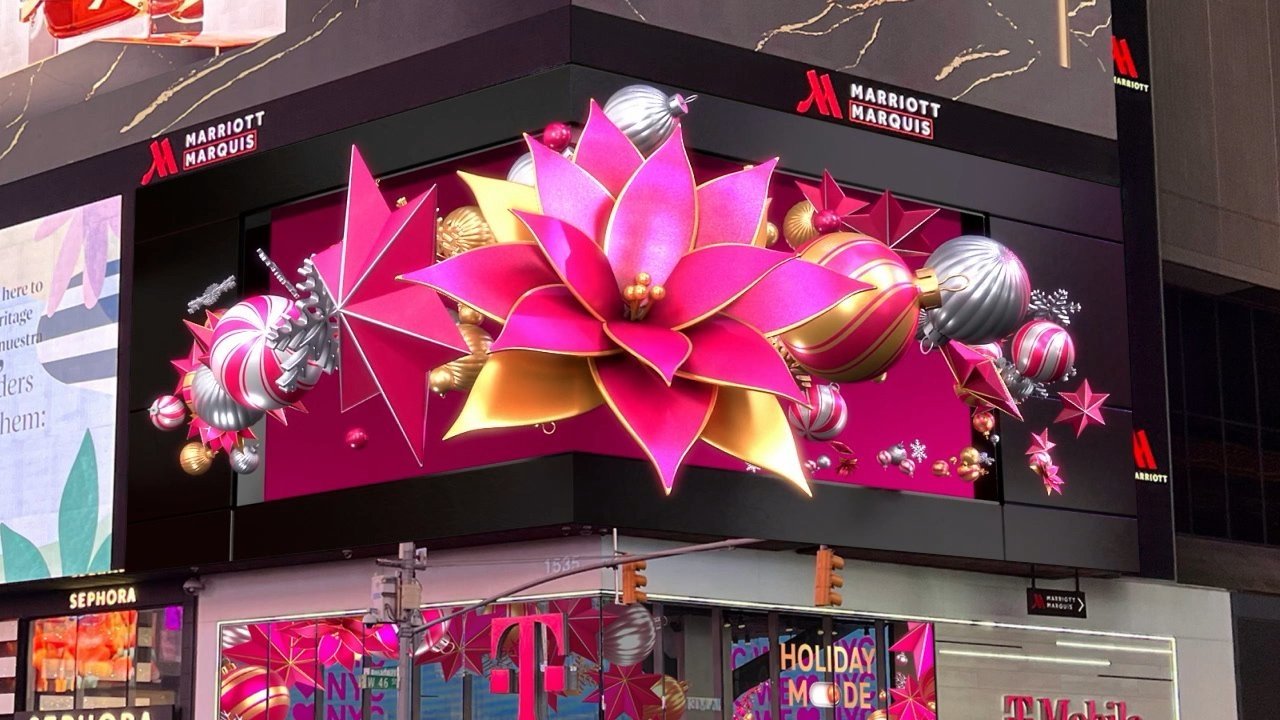
A 5D billboard is a marketing term commonly used to describe a naked-eye 3D LED billboard that creates an immersive visual illusion without requiring special glasses. Most 5D billboards use large-format LED displays, anamorphic content design, and corner screen structures to make objects appear to extend beyond the screen boundaries.
How Does a 5D Billboard Work?

High-Resolution 3D LED Display Technology
These billboards use ultra-high-resolution LED screens to display 3D content with real depth, making images appear to extend beyond the screen surface—no special glasses required. This relies on extremely high physical pixel density, which gives you sharp image edges, clean product logos, and precise details without any blur or roughness.
When purchasing, always aim for the smallest pixel pitch your budget allows. This is the foundation of immersion. If you compromise here, all subsequent naked-eye 3D content will look grainy and undermine the premium quality your brand requires.
Naked-Eye 3D Content
This is not part of the screen itself, but a special video made using tricks of the eye. When making the video, a dark shadow or fake border is drawn around the main image. This fools the eye and makes the object look like it is jumping out of the screen. You must know that the screen is just a tool. For this video, you need to hire a team that has done good work before. They will make the video to fit your screen’s real size, viewing angles, and room lighting. You cannot simply apply templates found online, as the perspective will not align correctly. This will make your ad space look cheap.
Motion and Perspective Adjustment
Most commercial 5D billboards do not use real-time eye-tracking. Instead, content creators calculate a fixed viewing position and design anamorphic visuals specifically for that angle. Interactive versions may integrate cameras, sensors, or AI-based audience tracking, but these systems are not required for standard 5D billboard installations. The system then slightly bends the image based on that. In this way, objects keep their 3D shape as you move around. If you want to make floor-level ads that let people walk up to the screen and play with the content, you need this feature. It keeps the view looking right from different angles.
However, if your screen is hung up high, seen from far away, and from one fixed spot, this feature is not worth the money.
Corner Screen Design
Corner screens are the most common structure used for 5D billboards because they enhance depth perception. It uses the 90-degree corner of a building. Two LED screens are put up. One shows the front of the object, the other shows the side view. When you stand at the right spot in front of the corner, your brain joins the two images. You see one full 3D image floating in the air. When picking a spot, find a building with a right-angle corner. There must be an open square or path in front.
In addition, flat and curved LED displays can also create naked-eye 3D effects when paired with properly designed anamorphic content.
Key Technical Specifications for a 5D Billboard

Pixel Pitch
Pixel Pitch is the space between the centres of two LEDs, measured in millimetres. For example, P3 means 3 millimetres. A smaller number means more dots in the same area. This gives you higher sharpness and a finer picture. For outdoor screens viewed from 15 meters or more, P5 to P8 works well. It balances good looks and cost. But for close-up use, like mall halls or shop windows where people stand just 2 to 5 meters away, you must pick P2.5 or smaller. If not, the blocky look will be very clear. This will hurt your brand’s image.
Brightness
This is how bright the screen shines per area, measured in nits. Outdoor LED screens must stay clear in strong sunlight. So, they need 5,000 to 8,000 nits. Below that, the image looks dull and grey. Indoor LED screens are different. They only need 1,500 to 2,500 nits. More than that can hurt the eyes and cause light pollution.
When you buy the product, make sure it has a driver IC system with auto light sensing. This system changes the screen brightness based on the surrounding light. So, the view stays comfy all the time. It also helps cut power costs and slows down wear on the LED chips. This makes the screen last longer.
Refresh Rate
Refresh rate is how many times the image shows up on the screen each second, measured in hertz. Normal screens have 960 to 1920 hertz. But when you film them with a phone, you see clear scan lines.
For your 5D project, you must ask for a refresh rate of 3,840 hertz or more. A big part of these electronic billboards‘ power comes from people taking photos and sharing them on social media. A high refresh rate keeps the image sharp, with no flicker and no blur in every shot. This spec directly affects how well your content spreads online. Do not cut corners on this in the tech tender.
Viewing Distance
Viewing distance is how far people stand from the screen to see a full and comfortable image. A simple rule is this: the shortest distance in meters is about the pixel pitch number in millimetres times one. The best distance is the pixel pitch number times 1.2 to 1.5.
You must go to the site first. Measure the space from the screen spot to where most people will gather. Then work back to pick the right pitch. This is the most important first step. The viewing distance must come before picking the screen. Do not switch this order. If you do, you will waste money or get bad results.
Screen Size
Screen size means the visible area, rather than the device’s overall physical dimensions. Commercial LED billboards typically use refresh rates between 1920Hz and 7680Hz. For 5D advertising displays that are frequently photographed or filmed, 3840Hz or higher is recommended. Its vertical size needs a right match. This brings benefits: standard video sources display perfectly without stretching or distortion. It has full coverage and top clarity.
5D Billboard vs Traditional LED Billboard

| Factor | 5D Billboard | Traditional LED Billboard |
| Initial Investment | Higher due to custom structures and specialized content requirements | Lower with standard display configurations |
| Content Production | Requires professional 3D modeling, animation, and perspective design | Uses standard images and video content |
| Installation Complexity | Often requires corner structures or customized installation layouts | Standard flat-screen installation |
| Site Requirements | Works best in high-traffic commercial districts and landmark locations | Suitable for most outdoor advertising locations |
| Advertising Revenue Potential | Can support premium advertising rates for high-impact campaigns | Generally follows standard market advertising rates |
| Content Update Cost | Higher because 3D content creation is more specialized | Lower and easier to update regularly |
| Best Use Case | Brand launches, flagship stores, tourism attractions, and landmark advertising | Routine advertising, public information, and local marketing campaigns |
FAQ
Can an Existing LED Display Be Converted into a 5D Billboard?
These two displays cannot usually be replaced directly. This is not merely a matter of switching video content. The hardware design itself imposes fundamental limitations. The true 5D effect depends on the physical angle between the two displays, which utilises the spatial displacement between two adjacent walls to eliminate visual edges. If your current screens are simply flat and the steel frame structure cannot be altered, you will be unable to create the sense of depth that makes objects appear to float out of the screen.
How Much Does a 5D Billboard Cost?
The total cost typically ranges from several hundred thousand to several million RMB, depending primarily on the screen size, pixel pitch ( P4–P10), and the complexity of the structure. In addition to the display itself, you will also incur high additional costs, such as bespoke 3D video production, steel frame replacement, installation and commissioning, and the electricity costs required for operation.
What Brightness Is Required for Outdoor 5D Billboards?
Outdoor 5D advertising screens typically require a brightness of between 6,000 and 10,000 nits. High brightness is not only essential for daytime visibility, but also key to creating a three-dimensional effect. Only sufficiently intense light can counteract sunlight, preserve the high-contrast details in highlights and shadows within the image, and create a sense of depth in the light and dark areas of virtual objects.
How Often Does a 5D Billboard Require Maintenance?
Comprehensive inspections should be carried out two to four times a year, with particular attention paid to waterproofing and heat dissipation components. As part of routine maintenance, the backend software remotely monitors the equipment’s status, tracking temperature, voltage, and other operational data in real time. Regular checks are essential to ensure that the modules remain securely in place. Temperature fluctuations and changes in heat and cold can cause components to shift, and vibrations from the rack may also have an impact. Even the slightest pixel displacement can immediately ruin the meticulously crafted 3D effect.
Can a Flat LED Screen Create a 5D Effect?
No. A purely flat screen can only produce 3D images with a sense of direction through perspective rendering; its visual effects are always confined to a single plane. The so-called 5D effect must rely on L-shaped or curved corner structures, using physical orientation to extend the image onto the sides of the building. This ability to combine digital content with the actual physical form of a space is a hardware capability that flat-panel displays do not possess.
What Screen Size Is Recommended for a 5D Billboard Project?
A flat screen can only produce a three-dimensional effect resembling perspective, but lacks physical depth. So-called “5D” technology must employ a design that extends beyond the screen’s edges, utilising the space between two adjacent walls to create a spatial displacement effect that breaks free from the screen’s frame, allowing objects to appear to float out of or sink into the building structure. A flat screen is incapable of achieving this.
Can Multiple Advertisements Run on the Same 5D Billboard?
Yes. A time-based rotation is typically used. However, to ensure visual continuity, it is advisable not to insert standard 2D videos between two 3D ads, as this may disrupt the immersive experience. Technically speaking, a well-organised playlist can achieve seamless transitions.
Final Thoughts

Do you want a reliable 5D billboard solution that fits your space and budget? Contact us today for a custom plan and quote. Our team ensures easy setup and stable performance.

